
Cinematic Sabotage: How Bollywood’s Glorification of Rowdyism and Non-Compliance Contributed to Social Chaos and Disorder in the Indian Subcontinent
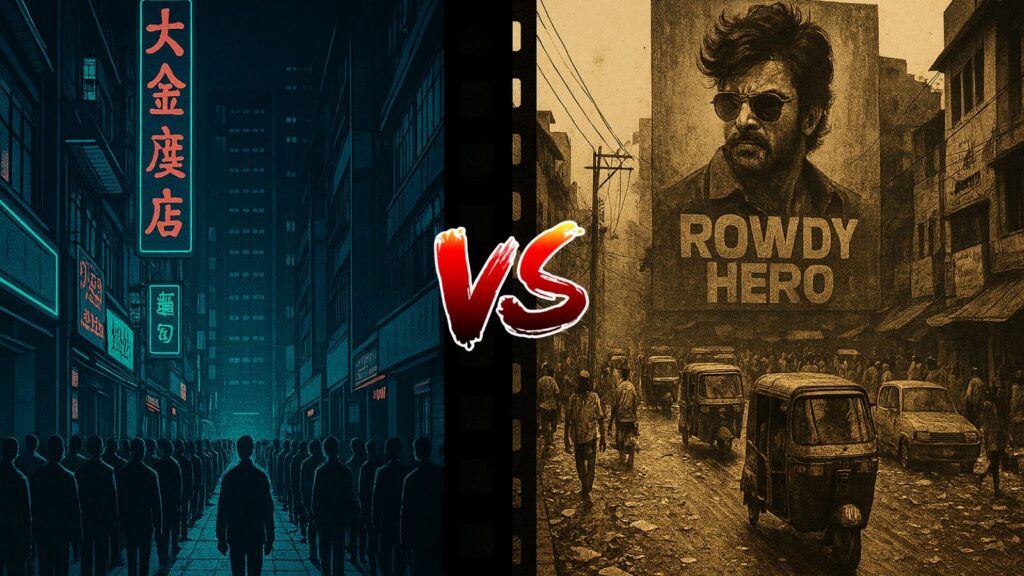

The streets of Shanghai, Tokyo, and even the capitals of the West share a silent, invisible infrastructure: the adherence to a system. In these societies, the individual understands that their 100 percent dedication to the organization and the ecosystem is the tide that lifts all boats. There is a quiet pride in the lack of friction, no litter, no broken traffic queues, no “twisting” of the law for personal gain.
Contrast this with the sprawling landscape of the Indian subcontinent. From the choked arteries of Mumbai and Karachi to the bustling markets of Dhaka and Colombo, a different philosophy reigns. It is the philosophy of the “Shortcut,” the “Jugaad,” and the “Rowdy.” For over half a century, the primary cultural export of this region, Bollywood, has acted as a silent programmer of the subconscious. It has not merely entertained; it has built a “Cinematic Architecture of Mediocrity.”
We have been fed a steady diet of the “Resourceful Rebel”, the man who is celebrated for his “machoism” precisely because he is “daring” enough to break the system. While Western and East Asian societies were being conditioned toward discipline, the residents of the Indian subcontinent were being conditioned to view the law-abiding citizen as a “weakling” and the system-breaker as a “hero.” This is the story of how three hours of escapism transformed into decades of societal stagnation.
The Glorification of the Systemic Saboteur
To understand why a professional in a Chinese company gives 100 percent to their organization while an employee in the subcontinent often looks for the “minimum viable effort,” we must look at who we have been told to admire.
Since the 1970s, the “Protagonist” in subcontinental cinema has shifted away from the builder and toward the destroyer. The “Angry Young Man” trope, while originally a cry against corruption, mutated into a celebration of the “Rowdy.” In this cinematic universe, being “resourceful” isn’t about innovation; it’s about “setting” things, twisting the law, bribing the official, or using physical intimidation to bypass the queue.
This has created a deep-seated psychological complex across India, Pakistan, and Bangladesh. When your role models, played by demigods of the silver screen, gain fame and love by being “pushy” and “defiant,” the average citizen begins to mirror that behavior in the mundane reality of life.
- On the Road: Breaking a traffic light isn’t seen as a danger to the ecosystem; it’s seen as being “daring.”
- In the Office: Following a protocol is seen as being a “cog in the machine,” whereas finding a loophole is seen as “intelligence.”
The result is a society that functions at 50 percent capacity because 50 percent of its energy is spent trying to outsmart the very systems meant to protect it.
The East Asian Discipline vs. The Subcontinental Shortcut
The divergence between the Indian subcontinent and the burgeoning economies of East Asia, specifically China, is not merely a matter of GDP or infrastructure; it is a matter of Civic Consciousness. In the Chinese organizational model, there is a pervasive culture of “Total Commitment.” An employee does not just work for a paycheck; they work as a cell within a larger organism. They understand that littering, breaking traffic rules, or providing subpar effort at work creates “friction” in the collective ecosystem.
In the subcontinent, Bollywood has systematically dismantled this collective responsibility. By glamorizing the “Macho” who stands above the law, cinema has socialized millions into a state of Individualistic Chaos.
- The “Jugaad” Trap: While often celebrated as “frugal innovation,” the cinematic version of Jugaad is actually the glorification of the “hack.” It suggests that we don’t need to build robust, world-class systems like the West or Japan; we just need to be “clever” enough to bypass them.
- The Erosion of Merit: When movies suggest that success comes through “clout” and “rowdyism” rather than disciplined competence, the desire for professional excellence withers.
- The Ecosystem Harm: Because the “Hero” never waits his turn, the audience learns that “waiting your turn” is for the powerless. This manifests in the daily anarchy of our traffic and the casual disregard for public spaces.
While the Chinese citizen is conditioned to ask, “How can I ensure the system works?”, the Bollywood-fed subcontinental resident asks, “How can I ensure the system works for me, at the cost of everyone else?”
Defending the “Art” and the Exception of Bhutan
Critics often argue that “cinema is just entertainment” and that it reflects society rather than shaping it. However, this ignores the unique status of actors in the subcontinent, where they are not merely performers but demi-gods whose hairstyles, clothing, and, most importantly, behavioral tics are imitated by the masses. When a superstar spits on the road with “swag” or drives a vehicle onto a pavement to avoid a jam, he isn’t just acting; he is issuing a license for mediocrity to millions.
The case of Bhutan serves as a vital counter-point. Nestled within the same geography, Bhutan remains an organized, disciplined, and deeply mindful society. Why? Because their cultural pillars, rooted in Gross National Happiness and traditional values, prioritize the “Ecosystem” over the “Ego.” They have resisted the wholesale adoption of the “Rowdy” archetype.
Bhutan proves that subcontinental genetics are not prone to chaos; rather, the cultural software we choose to run determines our output. By choosing the Bollywood “Rowdy” template, the rest of the subcontinent has opted for a lifestyle of false machoism, a “glory” that comes at the cost of a broken society. We have traded the quiet dignity of a functioning civilization for the loud, hollow fame of the “resourceful” lawbreaker.
Frequently Asked Questions about Bollywood’s Societal Impact
Q1: How does Bollywood influence the civic sense of the Indian subcontinent? A: Bollywood acts as a behavioral blueprint. By frequently depicting “cool” protagonists who bypass queues, ignore traffic rules, or intimidate officials, it socializes the audience to view law-abidance as a sign of weakness and systemic non-compliance as a mark of “macho” resourcefulness.
Q2: Why is the “Rowdy” trope so harmful to professional environments? A: The “Rowdy” archetype prioritizes personality over protocol. In corporate or organizational settings across the subcontinent, this translates to a lack of discipline and a preference for “shortcuts” (Jugaad) over the 100% dedication and systematic excellence seen in East Asian work cultures.
Q3: Is it fair to blame cinema for deep-seated societal issues like littering? A: While cinema isn’t the sole cause, it is a primary reinforcer. In a region where stars are role models, the lack of cinematic emphasis on civic duty, coupled with the glamorization of “devil-may-care” attitudes, creates a cultural climate where harming the ecosystem is seen as inconsequential.
Q4: How does Bhutan differ from its neighbors in terms of discipline? A: Unlike the rest of the subcontinent, Bhutanese society is anchored in collective mindfulness and Gross National Happiness. By prioritizing the ecosystem and traditional values over the hyper-individualistic “machoism” exported by mainstream cinema, they maintain a highly organized and respectful society.
Q5: Has Bollywood ever tried to promote high values and commitment? A: While there are exceptions, films that focus on social reform or national duty, they remain outliers. The vast majority of high-budget commercial cinema relies on the “rebel” formula, which continues to feed a narrative of false machoism to the masses.
Conclusion
The tragedy of the Indian subcontinent is not a lack of potential, but a misdirected sense of “heroism.” For decades, we have looked at the screen and mistaken chaos for charisma. We have built a society where the man who follows the rules is ridiculed as a “coward,” while the man who breaks them is heralded as a “lion.” This cultural programming has consequences that reach far beyond the cinema hall, it is written in our gridlocked traffic, our neglected public spaces, and our struggle to compete with the disciplined organizational might of the East.
If we are to move from a “mediocre society” to a world-class civilization, the first step is a collective “unlearning.” We must recognize that true machoism lies in the strength to be disciplined, and true resourcefulness lies in building systems, not bypassing them. Bollywood has fed the subcontinent a steady diet of toxic shortcuts; it is time we demand a culture that values the ecosystem over the ego.
The “Asian Century” belongs to the disciplined. Until the residents of India, Pakistan, Bangladesh, and beyond trade their cinematic “rowdyism” for civic commitment, we will remain a subcontinent of great potential, perpetually held back by our own favorite stories.

Vineet Gupta is the Founder and Managing Editor of MBA Study Point. He is an alumnus of the University of Wales, UK, where he completed his MBA. Along with his work across hospitality, finance, media, and academia, he has spent more than 14 years teaching MBA students at reputed institutions across India. His wide professional exposure and time spent observing people, workplaces, and cultures have shaped his interest in mindful living, leadership, and personal development. Through MBA Study Point, he brings together these experiences to help readers find clarity, balance, and practical wisdom for both career and life.