
50 Years, Zero Potholes: The Incredible Story of Pune’s JM Road as it Hits Golden Jubilee on January 1, 2026
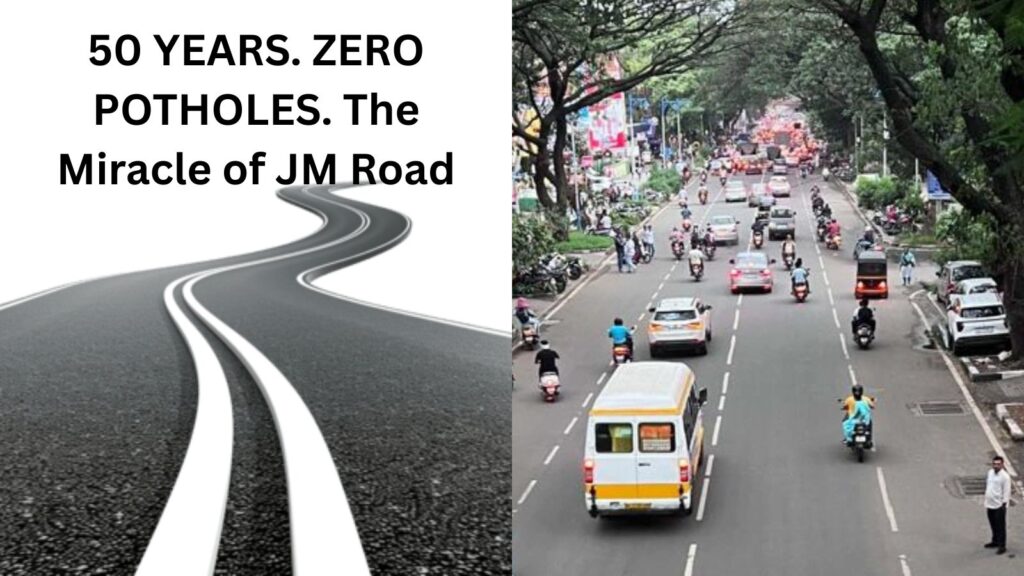

PUNE – In a country where monsoon rains often act as a “quality test” that most urban roads fail within weeks, one 2.3-km stretch in the heart of Pune is preparing to celebrate a milestone that seems almost mythical. On January 1, 2026, Jangli Maharaj (JM) Road officially completes 50 years of service, without ever having reported a single structural pothole.
As the city battles recurring infrastructure woes, the “Golden Jubilee” of JM Road stands as a stinging reminder of what happens when engineering integrity triumphs over the “repair-and-bill” cycle.
The 1973 Crisis: How ‘Monsoon Anger’ Built a Legacy
The story of JM Road began not with a celebration, but with a catastrophe. In 1973, Pune was devastated by floods that left the city’s transit system in ruins. Public anger was at an all-time high as roads washed away like sandcastles.
Enter Shrikant Shirole, the then 24-year-old Chairman of the PMC Standing Committee. Shirole refused to accept the standard “heavy rain” excuse. Noticing that Mumbai’s roads, despite higher rainfall, remained intact, he bypassed traditional bureaucracy to find the men responsible: a Mumbai-based firm called Recondo.
The Recondo Promise: A 10-Year Written Warranty
In an unprecedented move for Indian civic administration, Shirole awarded the contract to Recondo, owned by two Parsi brothers, without a public tender. The cost was ₹15 lakh, a staggering sum in 1974 when gold was ₹400 per 10 grams.
However, the price came with a legendary condition: a 10-year written warranty. Recondo guaranteed that if a single “dent” or pothole appeared within a decade, they would reconstruct the entire road at their own expense.
The Genius of Norman Henry Taylor: The Science Behind the Surface
The secret to the road’s immortality lies in the “Hot Mix” asphalt technology introduced by Norman Henry Taylor, an English engineer and asphalt expert who was the founding director of Recondo Ltd.
- Hot Mix Technology: Unlike the lukewarm mixtures often used today, Taylor’s method involved heating bitumen and aggregates to exactly 160°C, ensuring a perfect, crack-resistant bond.
- The “No-Dig” Architecture: The road was future-proofed with utility ducts for cables and storm water drains placed along the edges and footpaths.
- The Pact: PMC agreed to a strict “no-digging” clause on the main carriage-way, a rule that has largely been respected for half a century.
A Bitter Legacy: Why wasn’t it replicated?
Despite the undeniable success of JM Road, the “Recondo Model” was never replicated in Pune. Historical accounts and civic activists suggest a grim reason: the road was too good.
“The municipal corporation waited five years to test Recondo’s claims. By then, new committees preferred cheap tenders over miracles,” Shirole recently noted. The lack of recurring repair contracts meant fewer “commissions” for middlemen, effectively blacklisting the high-quality approach in favor of short-lived, low-bidder projects.
JM Road at 50: Still Pune’s Pride
Today, JM Road is a bustling commercial artery. It has survived the introduction of heavy PMPML buses, thousands of cars, and even the construction of a Metro line overhead. While it received a cosmetic “top-up” during the 2014 Smart City makeover, the 1976 foundation remains untouched and unyielding.
As Pune gears up for the Pune Grand Tour 2026 cycling event this January, JM Road remains the gold standard, a 50-year-old testament to the fact that pothole-free roads aren’t a dream; they are simply a matter of integrity and engineering.