

Stop us if you’ve heard this one:
“The MBA is dead. Why spend two years and six figures on a generalist degree when a 6-month certification in Data Science, Product Management, or UX Design can land you a high-paying job in half the time?”
It’s the existential crisis facing every ambitious professional today. The speed of skill acquisition has never been faster, and specialized credentials have never been more immediately valuable. You see headlines every week celebrating the specialized “doer” – the developer, the analyst, the marketer – while the traditional generalist MBA, who once commanded the corner office, seems to be losing ground. The argument is simple: Skills over Degrees. And, frankly, the threat is real.
But the conclusion is lazy, simplistic, and deeply flawed.
The truth is, the war isn’t between the MBA and the skilled professional. The real battle is between the outdated generalist and the future-proof strategic leader. And the $40,000 question isn’t whether the MBA is relevant, but whether your MBA – the one you’re considering investing $40,000 to $200,000 and two years of your life into – will deliver the new, hybrid skills the market is actually hungry for.
At MBA Study Point, we’ve spent years analyzing the career trajectories of successful executives in FinTech, Big Tech, and global consultancy. What we’ve discovered is that the highest earners – the ones who rise to VP, C-suite, and Partner level – are not just great specialists, and they are not just generic MBAs. They are a rare breed who mastered the Strategic Skill Stack.
This stack is the combination of deep technical expertise and broad business vision. And it is the only way to safeguard your career against disruption.
In this definitive guide, we will break down:
- The critical flaw in pursuing specialization alone (The $100K ceiling).
- The Four Pillars of the future-proof management professional – the specific technical and soft skills that matter more than the brand name of your school.
- A practical framework for mapping your MBA curriculum to ensure you build this high-value, hybrid skill set.
If you’re deciding on an MBA, or worried that your current one isn’t enough, this is your roadmap. Stop asking if the MBA is dead, and start learning how to make yours unstoppable.
1. The Myth of the “MBA Killer” Skill Stack: Why Specialization Hits a $100K Ceiling
The most common narrative today is that specialization is the ultimate path. If you can code, if you can analyze market trends using R or Python, or if you can design a flawless user experience in Figma, you are immediately valuable. This leads to quick career wins, but it hits a wall – the ceiling of execution.
A brilliant Data Scientist can build the most accurate predictive model, but if they cannot communicate its strategic implications to the CEO, they remain a technician. A high-achieving Product Manager can build a flawless product roadmap, but if they cannot understand the CFO’s capital allocation constraints or the legal team’s regulatory compliance issues, their vision stalls.
The Specialist’s Trap:
- Focus is Narrow: They know the how (the mechanics of their skill) but not the why (the overarching business strategy).
- Influence is Limited: They lack the common language of business – P&L statements, valuation models, market entry strategy – needed to influence non-technical executives.
- The $100K to $150K Ceiling: This is often where the highly compensated specialist peaks. To move beyond this and into true leadership roles (Director, VP, General Manager), the requirements fundamentally shift from execution to strategy.
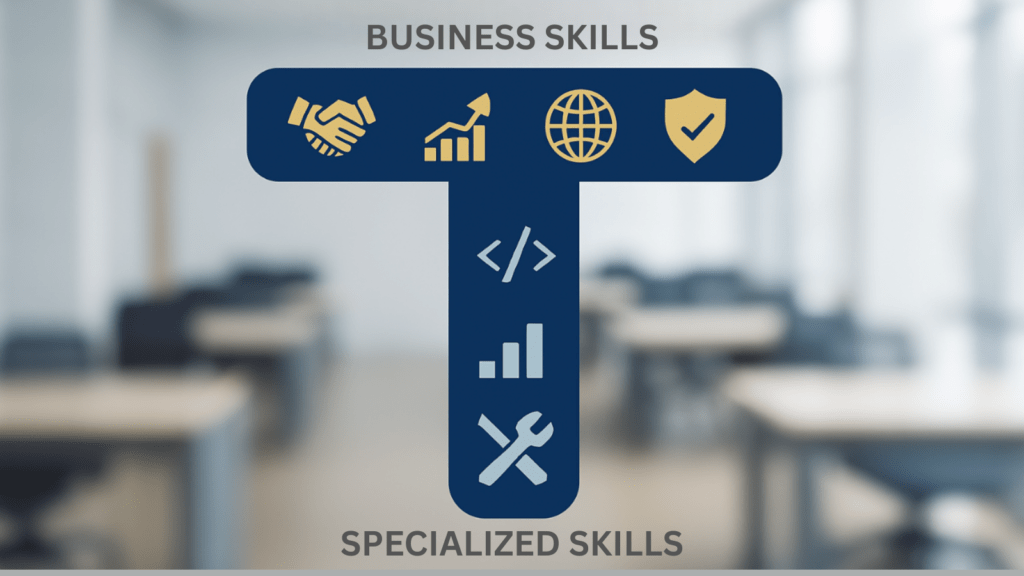
The market isn’t looking for a war between the degree and the skill. It’s looking for the T-Shaped Professional: someone with deep, specialized expertise (the vertical line), underpinned by broad, strategic business acumen (the horizontal bar). The vertical is the skill stack that gets you hired; the horizontal is the MBA knowledge that gets you promoted.
The MBA, when leveraged correctly, is not a threat to specialization – it is the accelerator that transforms the specialist from an expensive doer into a rare, highly paid leader.
2. The Four Pillars of the Future-Proof Management Professional (The T-Shape Blueprint)
If you are a prospective MBA student, your goal is to exit the program with a mastery of these four essential skill pillars.
Pillar 1: Data-Driven Storytelling (The Analytical Vertical) 📊
A specialist knows how to pull data. A future-proof leader knows how to turn that data into decisive action.
- What it is: The ability to simplify complex data narratives and communicate the strategic implications to a non-technical board.
- Why the MBA is Crucial: The MBA teaches you the strategic context (finance, marketing, operations) to correctly frame the data. You move from reporting on numbers to creating strategy with them.
- The Curriculum Focus: Prioritize courses like Business Analytics, Econometrics, and Decision Science integrated with Strategic Management.
Pillar 2: Complex System Agility (The Operational Vertical) ⚙️
Leadership requires the ability to see and manage the interconnected parts of the business as a complex system (global supply chains, decentralized teams, digital infrastructure).
- What it is: The skill to manage technical implementation, optimize cross-functional team workflows (Agile/Scrum), and reduce friction points in massive operational networks.
- Why the MBA is Crucial: Operations Management teaches you trade-off analysis – how to balance quality against cost, speed against risk, and inventory against demand.
- The Curriculum Focus: Deep specialization in Operations and Supply Chain Management, especially tracks that incorporate modern tools like AI in logistics and ERP systems.
Pillar 3: Adaptive Leadership & Influence (The Soft Skill Bridge) 🤝
This is the most potent counter-argument to the “skills over degrees” narrative.
- What it is: The ability to lead teams of specialists whom you don’t technically manage, navigate corporate politics, negotiate high-value contracts, and build an ethical organizational culture – leading through influence, not just authority.
- Why the MBA is Crucial: The MBA environment is a leadership laboratory where you master the “horizontal” bar: the art of connecting and leveraging all parts of the business.
- The Curriculum Focus: Prioritize courses in Negotiation Strategy, Organizational Behavior, Ethics, and Change Management.
Pillar 4: Commercial Innovation & Monetization (The Strategic Horizontal) 💡
This is the classic MBA strength, now hyper-focused on disruption.
- What it is: The skill to identify a market gap, develop a viable business model, calculate the Return on Investment (ROI) of a new venture, and secure funding.
- Why the MBA is Crucial: Courses in Strategic Finance and Venture Capital give you the framework to correctly value a business, manage capital, and understand the economics of innovation.
- The Curriculum Focus: Deep specialization in Strategic Finance, Entrepreneurship, Private Equity/VC, and Advanced Marketing Strategy.
3. How to Turn Your MBA into a Skill Accelerator (Curriculum Mapping) 🗺️
Don’t let the degree happen to you; use it as a strategic toolkit.
Strategy 1: The New Specializations – Seek Hybrid Tracks
The smart money is on hybrid specializations that force the combination of skills:
- MBA in Business Analytics: Focuses on Pillar 1 (Data-Driven Storytelling).
- MBA in FinTech/Digital Strategy: Integrates Pillar 2 (Complex System Agility) and Pillar 4 (Commercial Innovation).
- MBA in Product Management: The ultimate T-Shaped degree, demanding technical, strategic, and soft skills.
Advanced Tip: Look past the official degree name. Study the course catalog. A program is only as good as the electives that allow you to customize your T-Shape.
Strategy 2: Prioritize Experiential Learning over Pure Case Studies
The future professional needs to solve current, real-time problems.
- Look for: Mandatory Consulting Projects with real companies, Hackathons integrated into the curriculum, and Immersion Labs. These experiences force you to immediately apply Pillars 1 and 3 in high-pressure environments.
- The Power of the Network: Your cohort is your future network. The relationships forged are not just social; they are your future access points to critical domain expertise in different sectors. This $70K Network is the ultimate horizontal stabilizer.
4. Objection Handling: “But I Already Have a Coding Degree!” (Career Acceleration)
If you already possess a deep vertical skill (e.g., coding, engineering, clinical research), the MBA is not a career change – it is the highest-level leverage point for career acceleration.
| Before MBA (Specialist Role) | After MBA (Strategic Role) |
| You manage: A project, a code base, or a small team of peers. | You lead: A business unit, a product line, or a complex market strategy. |
| You talk: In the technical language of your domain (Python, SQL, JIRA). | You talk: In the strategic language of the business (ROI, valuation, market expansion). |
The MBA shifts your career trajectory from one focused on technical execution to one focused on strategic leadership.
Frequently Asked Questions about MBA Relevance in Skilled Professions
Q1: How does an MBA accelerate the career of a skilled professional (e.g., Engineer or Data Scientist)? A: For a skilled professional, the MBA acts as a vertical career lift, shifting their role from technical execution to strategic management. It provides the C-suite language of finance, operations, and leadership required to manage entire business units, not just projects.
Q2: Is a specialized MBA (e.g., FinTech or Business Analytics) better than a General MBA today? A: In an increasingly specialized market, yes. Specialized MBAs are often viewed more favorably because they deliver the T-Shaped Professional – combining deep technical focus (the vertical skill) with broad business acumen (the horizontal knowledge).
Q3: What are the three most important non-technical soft skills an MBA provides for leadership? A: The most critical soft skills developed in an MBA program are Adaptive Leadership (guiding teams through uncertainty), High-Stakes Negotiation (securing deals and capital), and Complex Communication (translating data and strategy for diverse stakeholders).
Q4: Will I earn more money with a specialized certification (like CFA or PMP) versus an MBA? A: Specialized certifications can provide an immediate salary bump and faster role attainment, but the MBA typically offers a higher long-term earning potential and career ceiling. The MBA is the required credential for most executive-level positions ($200K+ salary range) because it signals holistic, strategic capability.
Q5: What is the optimal time to pursue an MBA after graduating with a technical degree? A: The optimal time is typically after 3 to 5 years of post-undergrad work experience. This ensures you have the technical depth and real-world problems (the “vertical”) to truly leverage the strategic frameworks taught in the MBA program (the “horizontal”).
Q6: What specific MBA coursework addresses the threat of automation and AI? A: Courses in Complex System Agility (Pillar 2) and Commercial Innovation (Pillar 4) are key. This includes subjects like Digital Transformation Strategy, AI Ethics and Governance, and Organizational Change Management.
Conclusion: The Degree isn’t Dead – It Just Got an Upgrade 🚀
The debate over the MBA’s relevance is ultimately a false choice. The question is not whether a specialized skill stack will replace the business degree; it’s how the most ambitious professionals will fuse the two.
The generalist MBA, the one that offered minimal specialization and relied solely on prestige, may be fading. But the new MBA – the one you now know how to design – is the most powerful career accelerator available. It transforms the skilled professional from a high-value executor into a strategic, holistic leader by giving them the four pillars: Data-Driven Storytelling, Complex System Agility, Adaptive Leadership, and Commercial Innovation.
You’ve invested time reading this because you are not content with reaching the $100K ceiling; you are aiming for the C-suite and the ability to truly shape a business. That kind of impact requires the breadth of vision that only a strategically leveraged MBA can provide.
Key Takeaway: Stop asking if the MBA is relevant. Start asking: “How will I use the MBA to master the four pillars and become the T-Shaped professional the market can’t afford to lose?”
ALSO READ | Understanding Workplace Conflict: Meaning, Types and Effective Conflict Resolution Techniques
Your Next Step: Informed Program Exploration
Now that you understand the Strategic Skill Stack, you possess the framework necessary to critically evaluate any MBA program. Your immediate next step is to examine program curricula, elective lists, and experiential learning opportunities through the lens of the Four Pillars. Prioritize schools that actively integrate technical specialization with strategic business learning.
Don’t just get an MBA. Get the future-proof MBA.

Vineet Gupta is the Founder and Managing Editor of MBA Study Point. He is an alumnus of the University of Wales, UK, where he completed his MBA. Along with his work across hospitality, finance, media, and academia, he has spent more than 14 years teaching MBA students at reputed institutions across India. His wide professional exposure and time spent observing people, workplaces, and cultures have shaped his interest in mindful living, leadership, and personal development. Through MBA Study Point, he brings together these experiences to help readers find clarity, balance, and practical wisdom for both career and life.