The Ultimate Guide to Air Purifiers in India (2026): What Manufacturers Don’t Tell You About Running Costs, Effectiveness and Maintenance

Living in India today means navigating a landscape where “fresh air” feels like a luxury of the past. From the smog-choked winters of Delhi-NCR to the rising industrial particulate matter in Pune and Mumbai, the quality of the air we breathe has become a national health crisis. As we move through 2026, the reliance on technology to safeguard our indoor environments has shifted from a “lifestyle choice” to an absolute necessity.
This comprehensive guide for TotemScroll readers explores everything you need to know about air pollution, the science of Air Quality Index (AQI), and how to choose, maintain, and optimize an air purifier for your Indian home or office.
Understanding Air Pollution and the AQI Scale
Air pollution in India is primarily composed of Particulate Matter (PM2.5 and PM10), Nitrogen Dioxide, and Sulfur Dioxide. PM2.5, particles smaller than 2.5 micrometers, is particularly dangerous because it can bypass the nose and throat, entering deep into the lungs and even the bloodstream.
To help citizens understand these risks, the Central Pollution Control Board (CPCB) uses the National Air Quality Index (NAQI). This index transforms complex pollutant data into a single number and a color-coded warning.
Indian National Air Quality Index (AQI) Table
| AQI Category | Numerical Value | Color Code | Associated Health Impacts |
| Good | 0 – 50 | Green | Minimal impact. |
| Satisfactory | 51 – 100 | Light Green | Minor breathing discomfort to sensitive people. |
| Moderate | 101 – 200 | Yellow | Breathing discomfort to people with lungs, asthma, and heart diseases. |
| Poor | 201 – 300 | Orange | Breathing discomfort to most people on prolonged exposure. |
| Very Poor | 301 – 400 | Red | Respiratory illness on prolonged exposure. |
| Severe | 401 – 500 | Dark Red | Affects healthy people and seriously impacts those with existing diseases. |
The Hidden Cost: How Polluted Air Harms Your Health
Breathing polluted air isn’t just about a cough or a dry throat. Recent data from the Energy Policy Institute (EPIC) indicates that air pollution can reduce the life expectancy of the average Indian by over 3.5 years. In high-pollution zones like Delhi, this figure jumps to a staggering 8.2 years.
- Short-term effects: Irritation in the eyes, nose, and throat; headaches; dizziness; and fatigue.
- Long-term effects: Chronic respiratory diseases (Asthma, COPD), lung cancer, heart disease, and even adverse impacts on fetal development during pregnancy.
- Vulnerable Groups: Children (whose lungs are still developing) and the elderly are at the highest risk.
What can be done?
While systemic change requires government intervention (like the National Clean Air Programme), individuals can take “micro-level” actions:
- Monitor AQI daily using apps.
- Wear N95 masks when outdoors on “Poor” or “Severe” days.
- Plant indoor greens like Snake Plants or Peace Lilies (though their purification capacity is limited).
- Install a high-quality Air Purifier to control the indoor environment where we spend 90% of our time.
What are Air Purifiers and How Do They Work?
An air purifier is a device designed to “scrub” the air in a room by pulling it through various filters and circulating the cleaned air back out.
Common Filtration Technologies:
- Pre-filter: A mesh layer that catches large particles like hair, lint, and pet dander. It protects the more expensive internal filters.
- HEPA Filter (High-Efficiency Particulate Air): The gold standard. A true H13 Grade HEPA filter captures 99.97% of particles as small as 0.3 microns.
- Activated Carbon Filter: Essential for the Indian context to remove kitchen odors, smoke, and Volatile Organic Compounds (VOCs) from paints or cleaning agents.
- Ionizers/UV-C: These “kill” bacteria or clump dust. Caution: Some ionizers produce Ozone, a lung irritant; it is safer to stick to mechanical (HEPA) filtration.
2026 Air Purifier Comparison: From Entry-Level to Premium
When buying, look for the CADR (Clean Air Delivery Rate), which tells you how much air it can clean per hour.
| Model | Ideal Room Size | Price (Approx.) | Annual Filter Cost | Key Feature |
| Honeywell Air Touch V1 | 200–235 sq. ft. | ₹5,100 | ₹1,700 | Best budget pick; 3-in-1 basic filtration. |
| Levoit Core Mini | 180 sq. ft. | ₹5,900 | ₹1,800 | Compact personal unit with Aromatherapy. |
| Honeywell Air Touch V3 | 450 sq. ft. | ₹9,500 | ₹2,200 | Balanced performance with H13 HEPA. |
| Levoit Core 300 | 450–500 sq. ft. | ₹10,500 | ₹2,900 | High CADR for price; VortexAir tech. |
| Xiaomi Smart Purifier 4 | 400–450 sq. ft. | ₹13,000 | ₹2,500 | Best smart features & App connectivity. |
| Philips AC1711/15 | 300–380 sq. ft. | ₹12,500 | ₹2,800 | AeraSense technology; ultra-quiet. |
| Coway AirMega 150 | 350 sq. ft. | ₹14,500 | ₹3,500 | Longest filter life (8500 hrs). |
| Dyson Hot+Cool Gen1 | 500+ sq. ft. | ₹56,000 | ₹6,000 | HEPA H13 + Thermal regulation. |
Maintenance: Keeping Your Air Purifier Healthy
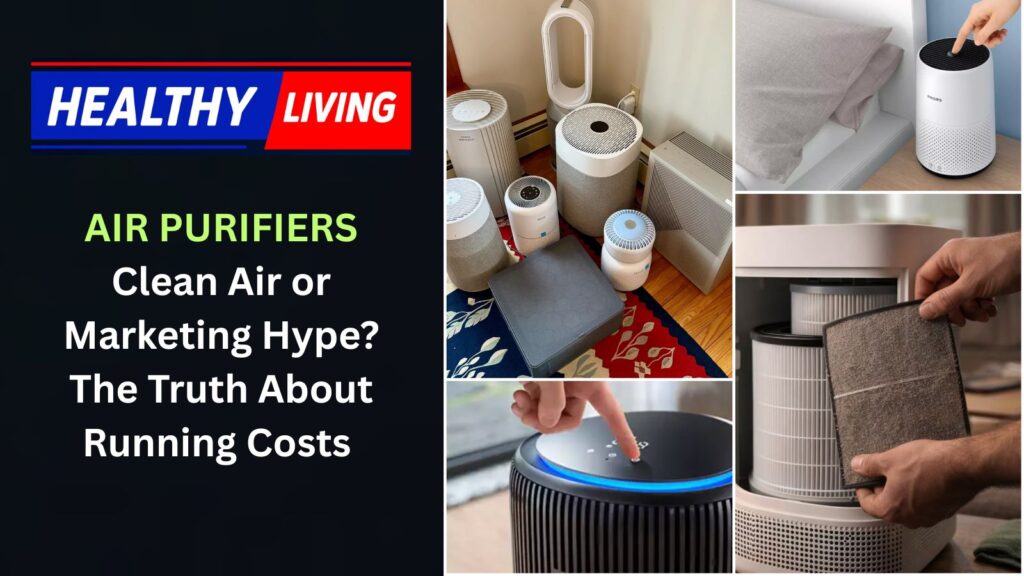
An air purifier is only as good as its filter. A clogged filter not only stops cleaning but can also stress the motor, increasing your electricity bill.
How to Clean Air Purifier
- Pre-Filter: Clean every 2 weeks. Vacuum the dust or wash it with water (if the manual allows). Ensure it is bone-dry before re-inserting.
- HEPA & Carbon Filters: These cannot be washed. Vacuuming the surface can extend life by a few weeks, but they must be replaced every 6 to 12 months depending on the pollution levels in your city.
- Sensors: Use a dry cotton swab to clean the dust sensor (usually behind a small flap) every 2 months to ensure accurate AQI readings.
Should You Keep Windows Open or Closed While Using Air Purifier?
To get the most out of your air purifier, keep windows and doors closed.
Running a purifier with windows open is like running an air conditioner with the door open, it will never reach the target “coolness” (or cleanliness). Outdoor air brings in a fresh supply of PM2.5 faster than the machine can filter it out.
The Exception: If you are cooking and there is heavy smoke, or if you are using strong chemicals, open the window for 10 minutes for “flush ventilation,” then close it and put the purifier on “Turbo” or “Max” mode.
Frequently Asked Questions (FAQs) About Air Purifiers
Q1: Does an air purifier remove smells?
A: Only if it has an Activated Carbon filter. A HEPA filter alone only removes dust/particles, not gases or odors.
Q2: How many hours should I run it?
A: During peak pollution months (October to February), it is best to leave it on “Auto” mode 24/7. Modern units are very energy-efficient, often consuming less power than a ceiling fan.
Q3: Where should I place the unit?
A: Place it at least 1-2 feet away from walls or furniture to allow 360-degree air intake. The bedroom is the most critical room, as your body recovers during sleep.
Q4: Do air purifiers help with COVID-19 or viruses?
A: While HEPA filters can trap viral particles, they are not a guaranteed medical cure. However, they significantly reduce the concentration of airborne pathogens.
ALSO READ | Is Microwave Cooking Safe? Here’s What ICMR and the National Institute of Nutrition Say
Conclusion
As we look at the environmental challenges of 2026, investing in an air purifier is no longer a luxury for the elite, it is a foundational pillar of health, similar to a water purifier. By understanding the AQI levels in your city and maintaining your device properly with our Best Air Purifiers in India 2026 guide, you can turn your home into a sanctuary of health amidst the urban haze.
For more deep dives into healthy living and technology, stay tuned to TotemScroll.