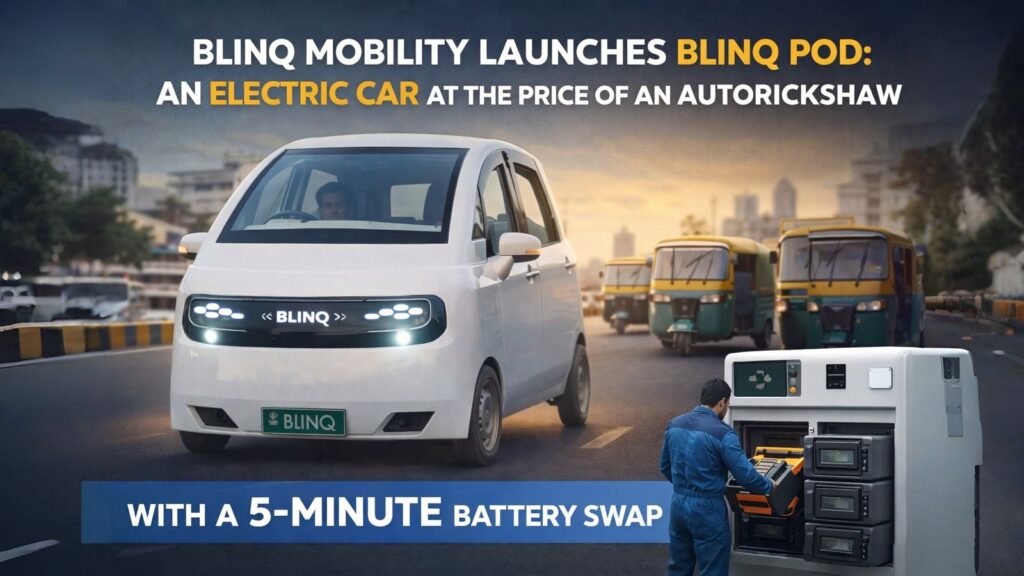

In a move that could redefine urban commute, Gurugram-based EV startup Blinq Mobility has officially launched its maiden electric vehicle, the Blinq Pod, with a starting price that directly undercuts traditional three-wheelers.
In the bustling streets of India, where the humble autorickshaw has long been the king of last-mile connectivity, a new challenger has emerged. Blinq Mobility, a deep-tech startup with roots in Gurugram and a pedigree that includes a former Tesla engineer, has pulled the veil off its first production-ready electric vehicle, the Blinq Pod. True to its mission of democratizing electric mobility, the company has priced this compact four-wheeler competitively with a new internal combustion engine (ICE) autorickshaw, potentially disrupting the market for fleet operators, gig workers, and urban families alike.
The “Autorickshaw Price” Decoded: Aggressive Pricing Meets BaaS
The biggest headline-grabber from this launch is, without a doubt, the pricing strategy. While the exact ex-showroom price varies by location and battery option, industry reports suggest the Blinq Pod will be priced between approximately ₹3.30 lakh to ₹3.80 lakh (ex-showroom). This aggressive price point puts it in direct competition with conventional three-wheelers.
However, the real magic lies in the Battery-as-a-Service (BaaS) model. Blinq Mobility has cleverly structured its offering to ensure the upfront cost remains as low as possible. By effectively separating the vehicle chassis from the battery, customers purchase the Blinq Pod at this entry-level price and pay a subscription fee for the battery usage. This model, which has gained traction with models like the MG Comet EV and Tata Punch EV, slashes the initial investment barrier and assures customers of a fixed energy cost, making financial planning easier for fleet operators.
Designed for the Urban Jungle: Specs and Features
The Blinq Pod is not merely a cheap electric vehicle; it is a purpose-built machine designed specifically for the unique challenges of dense Indian cities. Early prototypes, which bore a resemblance to the iconic Tata Nano for its space-efficient design, have evolved into a distinct urban mobility solution.
Powertrain and Range:
While official ARAI figures are awaited pending certification, the Blinq Pod is expected to be offered with multiple swappable Lithium-ion battery options. Reports indicate two primary variants: a 4.8 kWh unit and a 6.4 kWh unit. This setup is expected to deliver a real-world range of approximately 80 to 100 kilometers on a single charge/swap cycle, more than sufficient for a full day of operation for a city cab or a daily commuter. The vehicle is electronically limited to a top speed of 45-50 km/h, which qualifies it under the quadricycle regulations, meaning it does not require a full car driving license in some regions? (Buyers are advised to check local RTO rules).
Built Tough, Yet Lightweight:
In a departure from traditional steel monocoque construction, Blinq has utilized proprietary composite materials for the body panels of the Pod. The company claims these custom panels are actually stronger than regular steel, allowing for futuristic design flexibility without compromising on structural integrity or occupant safety.
Seating and Utility:
Designed to maximize space in a minimal footprint, the Blinq Pod comfortably seats four passengers (Driver + 3). This makes it an ideal replacement for the traditional auto-rickshaw, offering commuters the weather protection and comfort of a car at the same fare structure. It is also expected to have a cargo-focused variant for logistics and last-mile delivery applications.
The Game-Changer: Battery Swapping Technology
Perhaps the most significant technological highlight of the Blinq Pod is its focus on battery swapping. While most affordable EVs rely solely on plug-in charging, Blinq has designed the Pod from the ground up to facilitate quick battery swaps.
The company is developing a system where the battery pack can be “latched and de-latched smoothly,” potentially with a single command. This is a critical feature for high-utilisation users like cab drivers, who cannot afford the downtime of a 4-7 hour slow charge. By pulling into a Blinq swapping station, a driver could replace a depleted battery with a fully charged one in minutes, ensuring the vehicle stays on the road and continues earning. This focus positions Blinq Mobility as a potential competitor to existing battery-swapping networks.
The Masterminds: IIT Delhi Alumnus and a Tesla Engineer
Blinq Mobility is not just another flash in the pan. The company boasts a formidable leadership team that has given investors and the market confidence.
- Nikesh Bisht (Founder): An IIT Delhi alumnus and former CTO at Vecmocon Technologies, Bisht brings deep expertise in EV system architecture and product strategy.
- Ankit Kumar (CTO): The presence of Ankit Kumar, a former Tesla engineer who worked on the prestigious Tesla Cybertruck and Robotaxi programs, lends immense credibility to the startup. His expertise in advanced vehicle systems and EV architecture is crucial in taking the Blinq Pod from prototype to production.
The company recently raised Rs 4.3 crore in a pre-seed funding round led by 8i Ventures, with participation from IIMA Ventures and other angel investors, to fuel its pilot programs and certification drives.
How It Stacks Up: Blinq Pod vs. The Competition
To understand the impact of the Blinq Pod, it is essential to look at the current market landscape for affordable electric mobility in India.
The table below compares the Blinq Pod with the current cheapest electric cars available, highlighting the price gap the startup aims to bridge.
Data compiled from industry reports and listings as of March 2026.
As the table clearly shows, even with the BaaS model of the MG Comet (₹4.99 Lakh), the Blinq Pod undercuts the competition by a significant margin, positioning itself firmly in the “four-wheeled auto” category.
Road Ahead: Launch Timeline and Pilot Programs
Blinq Mobility is currently in an advanced stage of testing. The prototypes have been spotted testing on public roads, navigating gradients and city traffic to iron out real-world issues.
The immediate roadmap for the company in 2026 includes:
- Extensive Testing: Finalizing parameters and durability testing.
- Certification: Applying for necessary certifications to make the vehicle road-legal across India.
- Pilot Programs: Launching pilot fleets with select early customers and fleet aggregators in high-density urban areas to validate the battery-swapping ecosystem.
Frequently Asked Questions (FAQs)
While the final ex-showroom price varies by city, Blinq Mobility has positioned the vehicle aggressively. Industry estimates suggest the price will range between ₹3.30 lakh to ₹3.80 lakh (ex-showroom) , effectively matching the cost of a new diesel/CNG autorickshaw. This low entry price is facilitated by the Battery-as-a-Service (BaaS) model.
The Blinq Pod is expected to be offered with battery packs of 4.8 kWh and 6.4 kWh. This is anticipated to deliver a real-world driving range of approximately 80 to 100 kilometers per charge/swap, making it ideal for city commutes and last-mile connectivity.
Yes, battery swapping is a foundational feature of the Blinq Pod. The vehicle is designed to allow for quick battery swaps, reducing downtime to mere minutes. This is a key differentiator from many other affordable EVs that rely only on plug-in charging.
The company was founded by Nikesh Bisht (IIT Delhi Alumnus) and the team is led by CTO Ankit Kumar, a former Tesla engineer who worked on the Cybertruck and Robotaxi programs. This combination of Indian market knowledge and global EV expertise is a major strength for the startup.
The company is currently in an advanced testing and certification phase in 2026. They are expected to begin pilot programs with fleet operators soon. A wider public launch timeline has not been officially announced yet, but the vehicle is moving closer to production readiness.
Conclusion: A Glimpse into the Future of Mobility
The launch of the Blinq Pod is more than just a product unveiling; it is a statement of intent. By targeting the price point of an autorickshaw, Blinq Mobility is not just selling a vehicle; it is offering an upgrade. It promises auto drivers a safer, more comfortable, and weather-protected working environment while giving city commuters an affordable, clean, and efficient alternative for short trips.
If Blinq Mobility successfully executes its battery-swapping network and delivers on its claimed specs, the Blinq Pod could very well be the catalyst that accelerates the electrification of India’s vast last-mile transportation sector. The wait for a truly affordable electric car might finally be over.