India’s Largest Circular Stone Labyrinth Discovered in Solapur: 2,000-Year-Old ‘Chakravyuh’ Linked to Roman Trade
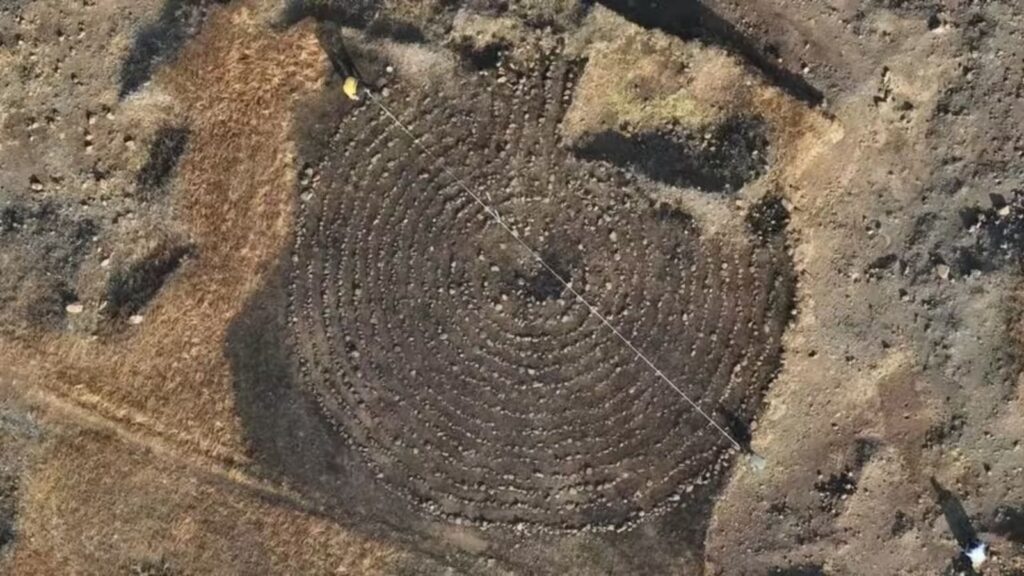

SOLAPUR: In a discovery that bridges the gap between the Deccan interior and the Mediterranean world, archaeologists have confirmed the presence of India’s largest circular stone labyrinth in the Boramani grasslands of Maharashtra. Measuring approximately 50 feet by 50 feet and featuring an unprecedented 15 concentric circuits, this ancient structure is being hailed as a “missing link” in the history of Indo-Roman trade and maritime navigation.
A 2,000-Year-Old Engineering Marvel in the Grasslands
The massive structure, found roughly 20 km from Solapur city, dates back nearly two millennia to the Satavahana Dynasty (1st–3rd Century CE). While a square labyrinth in Gedimedu, Tamil Nadu, covers a slightly larger area, the Boramani find is now officially the largest and most complex circular labyrinth ever recorded in India.
Until this discovery, the most complex circular labyrinths in the country featured only 11 circuits. The jump to 15 circuits signifies a level of geometric precision and symbolic depth previously unknown in the region.
The Accidental Discovery: Wildlife Conservation Meets Archaeology
Ironically, the site was not found through a formal excavation. Members of the Nature Conservation Circle (NGO), including Pappu Jamadar and Sachin Sawant, stumbled upon the stone rings while monitoring the critically endangered Great Indian Bustard and Indian wolves.
Recognizing the intentionality of the stone placement, they alerted Archaeologist Sachin Patil from Deccan College, Pune. His on-site inspection on December 17, 2025, confirmed that the 1.5 inches of soil accumulated between the rings indicated the structure had remained undisturbed for centuries.
The Indo-Roman Connection: A Signpost for Mediterranean Merchants
One of the most compelling aspects of the discovery is its design. The 15-circuit pattern closely resembles motifs found on ancient coins from Crete, which served as Roman currency during the Satavahana period.
Archaeologists suggest that these labyrinths served as symbolic signposts or navigational markers for Roman merchants. These traders traveled inland from the Maharashtra coast to trade gold, wine, and precious stones for Indian spices, silk, and indigo.
“The presence of labyrinths across Sangli, Satara, and Solapur suggests this entire belt was a bustling trade route—a ‘Western Indian Silk Road’—for Graeco-Roman merchants,” noted P.D. Sabale, Head of Archaeology at Deccan College.
Cultural Hybrid: The Classical Circuit meets the ‘Chakravyuh’
While the structure follows the “classical” labyrinth family found in Europe, it features a uniquely Indian twist. Jeff Saward, editor of the international journal Caerdroia, pointed out that the addition of a spiral at the very center is a feature specific to Indian tradition, often referred to as a Chakravyuh.
Significance of the Boramani Labyrinth
- Trade Hubs: The discovery reinforces the importance of ancient trade centers like Ter (Dharashiv) and Kolhapur.
- Religious & Ritual Use: Beyond trade, these “Kode” (puzzles) were likely used for meditation, fertility rituals, and as cosmic symbols.
- Preservation: Being located within a protected grassland sanctuary has saved the site from urban encroachment and agricultural destruction.
Future Research and Global Recognition
The discovery has already captured international attention. A detailed research paper by Sachin Patil is slated for publication in the 2026 edition of Caerdroia, the prestigious UK-based journal for maze and labyrinth studies.
As experts call for the urgent protection of the Boramani grasslands, this 15-circuit marvel stands as a testament to Maharashtra’s role as a vital crossroads in global commerce two thousand years ago.