

The Rise of “Slop”: Why AI is Making Social Media Boring (And Why That’s Good)
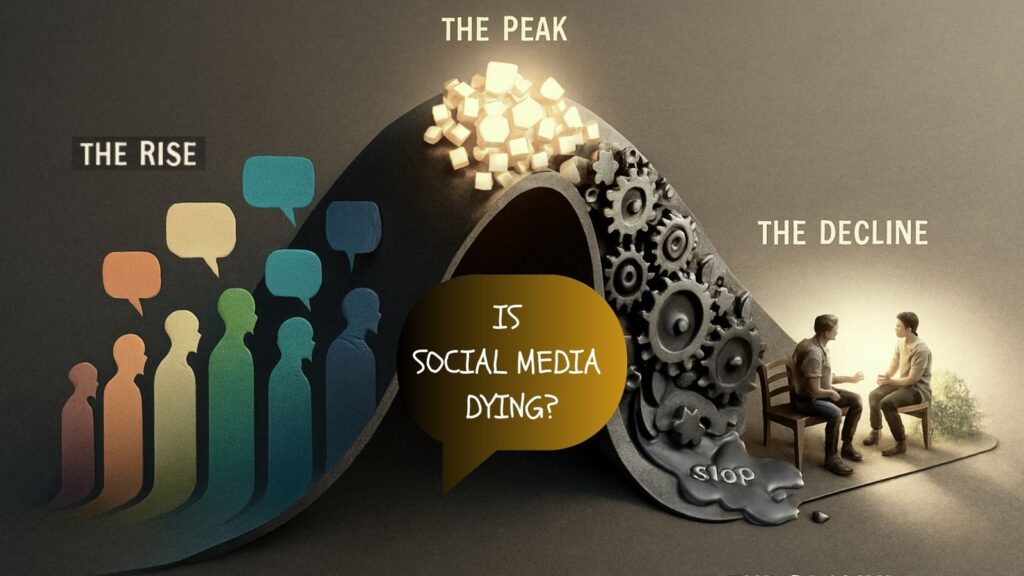

Remember when social media felt like a digital campfire? Now, it feels like a hall of mirrors and every reflection is generated by a prompt, not a pulse.
In 2008, social media was a revolution. In 2015, it was a utility. By 2025, it has become a landfill.
We are currently witnessing the final descent of the Social Media Bell Curve. For a decade, the utility of these platforms climbed steadily as they connected long-lost friends and birthed global movements. But we have passed the peak. The curve is now trending downward, accelerated by a silent, algorithmic toxin: Artificial Intelligence.
The very tool designed to “enhance” our digital experience is effectively killing it. As our feeds become choked with AI-generated “slop”, content that looks like a person, talks like a person, but lacks the soul of a person. We are reaching a point of collective exhaustion. The variety is gone. The unpredictability that makes humans interesting has been replaced by a polished, doctor-ed, and ultimately dull uniformity.
But for those of us who have felt the hollow ache of “scrolling for hours and feeling nothing,” this decline isn’t a tragedy. It’s a liberation.
The Bell Curve: From Connection to “Slop”
The trajectory of social media follows a classic bell curve. At the start, the value was high because the content was rare and deeply personal. As the platforms grew, we reached “Peak Social”, the sweet spot where enough people were online to make it useful, but not so many that the signal was lost in the noise.
Today, we are in the “Decline of Meaning.” The culprit? The sheer volume of AI production.
This isn’t just a feeling; it’s a measurable shift. The data reflects a growing exodus, with Gartner predicting that 50% of consumers will significantly limit their social media interactions by the end of 2025. The primary driver? A perceived decay in quality and the invasive spread of “toxic” AI-generated content.
- The Content Inflation: When anyone can generate 100 “high-quality” posts in an hour, the value of a single post drops to zero.
- The Loss of Variation: Because AI models are trained on existing data, they tend toward the “average.” This creates a feedback loop of sameness. Every travel photo looks like the same sunset; every “thought-leadership” post sounds like the same corporate drone.
- The Trust Deficit: Even when someone posts something genuine, we now view it with a squinted eye. “Is that real, or did an AI touch it up?” This skepticism is the death knell for social platforms, which rely entirely on the illusion of “social” connection.
The Predictability Trap: Why Perfection is Boring
The fundamental irony of AI on social media is that in trying to make everything “better,” it has made everything worse. Human interest is fueled by variation and vulnerability. We lean in when we see a flaw, a shaky camera angle, or a raw, unpolished thought. These are the markers of biological life.
AI, by its nature, optimizes for the “ideal.” When everyone uses AI to enhance their photos, refine their captions, and generate their hooks, the “ideal” becomes the “standard.” When everything is perfect, nothing is interesting.
- The Death of the “Discovery” High: We used to scroll to find something new. Now, we scroll through a predictable conveyor belt of algorithmic “slop” designed to keep us there, yet failing to engage us.
- The Narrative Chokehold: Large Language Models can produce content at a scale humans cannot match. This creates a “choking” effect on the feed. Genuine, original voices are being drowned out by high-frequency, bot-driven narratives that prioritize quantity over truth.
The result? We aren’t just losing interest; we are losing our sense of presence. We are realizing that posting original content into a sea of bots is like trying to whisper in a hurricane.
The Counter-Intuitive Silver Lining: A Return to the “Real”
It is easy to view the decline of social media as a cultural loss, but from a philosophical perspective, it may be the best thing to happen to human sanity in twenty years.
The Great Correction Social media was always a “pseudo-social” experience, a simulation of community without the responsibility of physical presence. It became a plague because it was addictive, hollowing out society by turning every life moment into a “performance” for likes.
Why the “AI Takeover” is a Gift:
- Breaking the Spell: As the digital world becomes more “fake,” our biological craving for the “real” intensifies. The more we recognize AI “slop,” the more we value a face-to-face conversation.
- The New Status Symbol: In an era of free AI content, physical presence and undivided attention are becoming the new luxury goods.
- Returning to the Tribe: If the rules of the platform no longer favor humans, humans will stop playing the game. We are seeing a slow migration back to “analog” socialization – dinner parties, local clubs, and physical gatherings where no algorithm can dictate the narrative.
Frequently Asked Questions about the Decline of Social Media
Q1: What is “AI Slop” and why is it ruining my feed? A: “Slop” refers to low-quality, AI-generated content—images, articles, or comments—flooding social media. It ruins feeds by drowning out genuine human interactions with repetitive, soul-less content that lacks original insight or emotional depth.
Q2: Is the “Dead Internet Theory” actually becoming real? A: While the internet isn’t literally “dead,” the theory—that most web traffic and content are bot-generated—is becoming a lived reality. As AI content production scales, the ratio of human-to-bot interaction is shifting, making the digital space feel hollow.
Q3: How can I tell if a social media post is AI-generated? A: Look for “uncanny perfection”: overly polished language, generic advice that says nothing new, or images with slight anatomical errors. More importantly, check for a lack of personal voice or specific, messy human experiences.
Q4: Will social media ever return to being “social” again? A: Likely not in its current form. As long as platforms prioritize algorithmic engagement over human connection, they will continue to trend toward AI automation. The “social” element is moving toward smaller, private, or physical communities.
Q5: Is it still worth posting original content online? A: Yes, but the goal is shifting. Rather than chasing “likes” (which are increasingly bot-driven), original content should serve as a beacon for real-world connection or deep, niche discussions among like-minded humans.
ALSO READ | Rage Bait: The New Cash Cow on Social Media Exploiting Our Anger and Outrage for Profit
The Inevitable Return to “Biological Socializing”
If the first half of the Bell Curve was about the excitement of digital expansion, the second half is about the exhaustion of digital dilution.
AI hasn’t just added more content to our lives; it has removed the “cost” of creation. And in human psychology, when the cost of a gesture becomes zero, the value of that gesture becomes zero. A “like” from a bot, a comment from an AI, or a perfectly doctored image of a “good life” no longer provides the hit of dopamine it once did. It just feels like noise.
The result? A cultural “Vibe Shift.” We are seeing the early signs of a mass return to genuine, physical interaction. When our digital feeds become “antisocial wastelands,” we will naturally seek out the only thing AI cannot replicate: the messy, unpredictable, and physically present human being. The silver lining of AI “killing” social media is that it might just save human society. By making the digital world unrewarding and dull, AI is pushing us back toward the dinner table, the local community center, and the physical handshake. We are trading “followers” for friends and “reach” for resonance.
The bottom line: Social media as a platform for human connection peaked years ago. AI is simply the “Great Eraser” that is cleaning the slate so we can start talking to each other again—offline.
What do you think? Has your screen time become a burden of “slop,” or do you still find the signal in the noise? Let’s debate this below. If you feel the “analog itch,” forward this to someone you’d rather meet for coffee than message on an app.
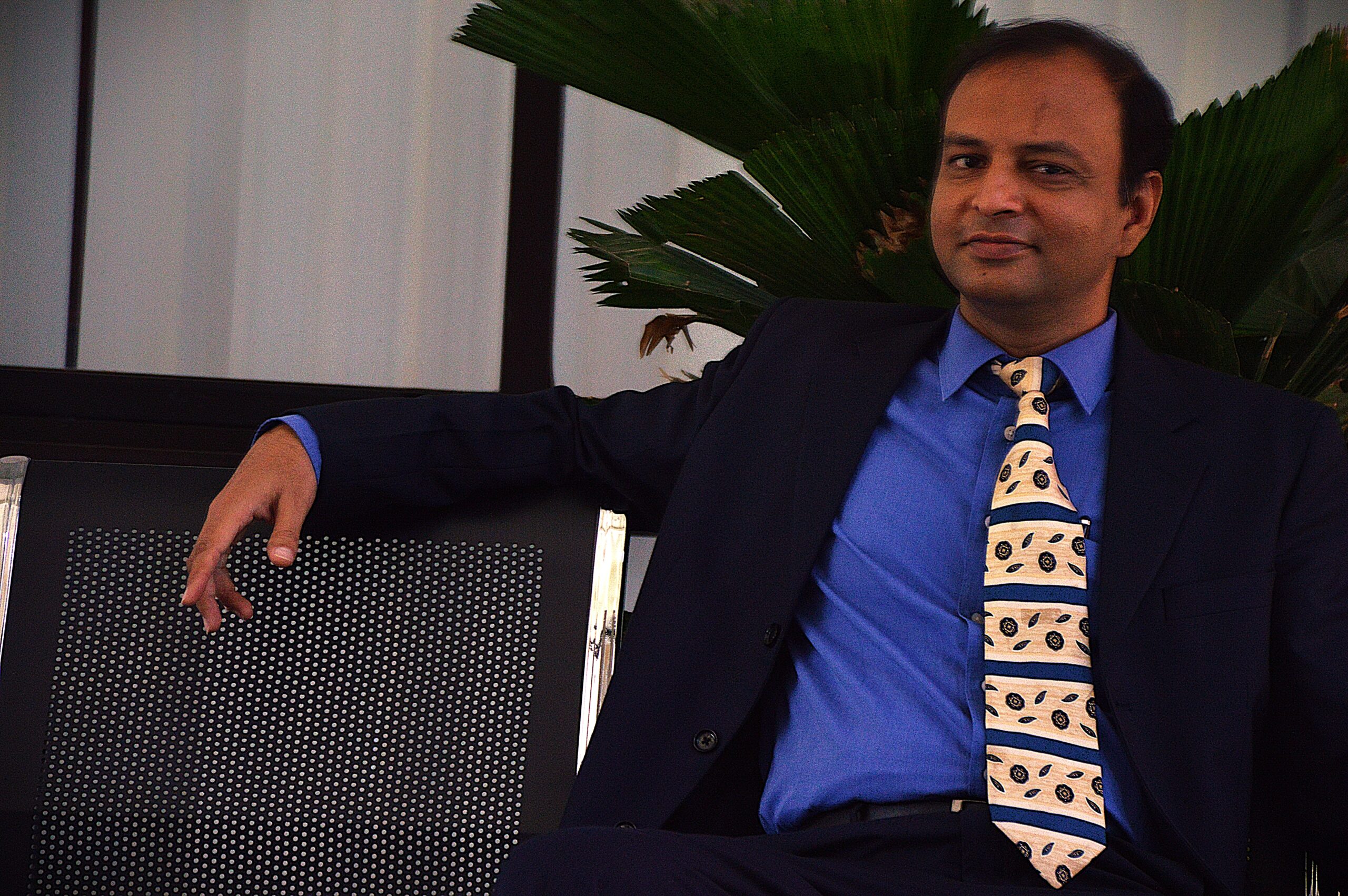
Vineet Gupta is the Founder and Managing Editor of MBA Study Point. He is an alumnus of the University of Wales, UK, where he completed his MBA. Along with his work across hospitality, finance, media, and academia, he has spent more than 14 years teaching MBA students at reputed institutions across India. His wide professional exposure and time spent observing people, workplaces, and cultures have shaped his interest in mindful living, leadership, and personal development. Through MBA Study Point, he brings together these experiences to help readers find clarity, balance, and practical wisdom for both career and life.






1 thought on “The Rise of “Slop”: Why AI is Making Social Media Boring (And Why That’s Good)”
Comments are closed.