
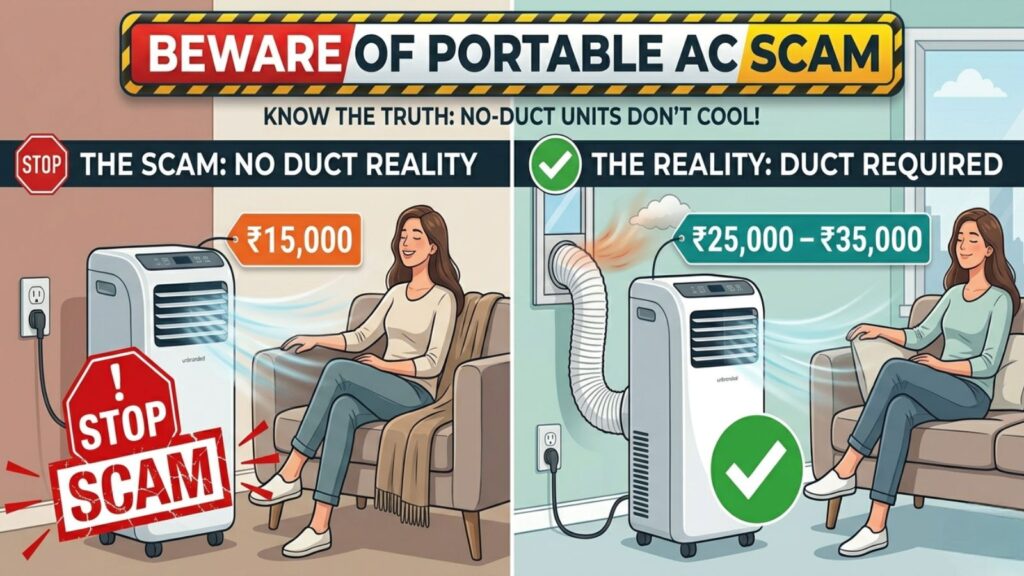

If you’ve scrolled through Instagram or YouTube Shorts this week, you’ve seen the reel: A warehouse stacked with LG, Voltas, or Samsung ACs, an influencer shouting that you can get a 1.5 Ton AC for just ₹15,000 to ₹20,000 in Delhi-NCR. The claim? True portability. No installation. No ducts.
But before you rush to Mundka or Gurugram to buy one, there is a harsh reality check. As temperatures hit 40°C across India, social media is flooding consumers with misleading information about portable air conditioners. We dug into the viral hype, the technical facts, and the hidden costs to uncover what you are actually buying.
The ‘Mundka Warehouse’ Scam: What the Viral Videos Don’t Show
Over the last 20 days, dozens of scripted videos have gone viral showing massive warehouses in Mundka, Delhi, and Gurugram. In these clips, influencers point to pallets of branded boxes, claiming stock is being cleared for absurdly low prices.
However, a physical investigation into these locations reveals a different story. When asked for prices on the spot, sellers provide standard market rates, matching online retailers like Amazon or Flipkart, not the viral discount. The “₹15,000 AC” is a classic bait-and-click tactic used to generate views and foot traffic. There is no stock of verified, branded 1.5 Ton split ACs at that price.
The Duct Dilemma: Why ‘Portable ACs’ Aren’t Truly Portable
The second layer of controversy involves the definition of a Portable Air Conditioner (PAC). Here is the core technical truth that social media influencers often hide:
True portable ACs are not plug-and-play.
Unlike an air cooler, a genuine portable AC (like the Blue Star BS-CPAC12DA or LG Dual Inverter) houses a compressor and uses refrigerant. Because it transfers heat (the Second Law of Thermodynamics), it must expel hot condenser air somewhere. You need a duct (a hose) connected to a window or a hole in the wall.
If you run a portable AC without the exhaust duct, it will actively heat your room. The compressor generates heat, and without the hose, that heat stays inside the house. The room will get hotter, not colder.
- Single-duct units: Pull air from the room to cool the compressor and push it out the window.
- Dual-duct units: Pull air from outside to cool the compressor (more efficient).
- The Reality: You still need a window kit or a cutout. You cannot place it in the middle of a room or a room with no window access.
The Air Cooler Impersonation
This is the biggest trap for Indian consumers right now. Many of the “USB” or “Mini” portable ACs trending online are not ACs at all, they are evaporative air coolers.
- How they work: They blow air over water-soaked pads. Evaporation creates a cooling effect.
- Ducts? No. They are truly portable.
- The Catch: They add massive humidity to the air.
- Who should avoid: If you live in Mumbai, Chennai, Kolkata, or any coastal region where humidity exceeds 60-70%, an air cooler will make your home feel like a sticky, damp mess. It will not cool you.
Even in dry regions (Delhi, Rajasthan), a cooler only works if the window is open. It adds moisture, whereas an AC dehumidifies the air.
Cost Analysis: Pocket Pinch vs. Cooling Relief
Before buying a portable AC or cooler based on a viral trend, check your monthly budget.
Portable AC (1 Ton)
- Price: ₹25,000 – ₹35,000
- Monthly Bill (8 hrs/day): ₹1,500 – ₹2,500
- Requires: Exhaust duct & window access
Tower Air Cooler
Split AC (1.5 Ton)
- Price: ₹32,000 – ₹55,000
- Monthly Bill (8 hrs/day): ~₹2,000 – ₹3,000
- Requires: Professional installation
Expert Verdict: Digit consultant Madhav notes that if you are spending ₹30,000+ on a portable AC, you are getting the cooling capacity of a smaller split AC but with the noise of a vacuum cleaner and a hose hanging out your window. At that price, unless your landlord strictly forbids drilling, a split AC is a superior long-term investment.
How to Spot a Misleading ‘Portable AC’ Ad
If you see a viral video promising the ultimate solution to Indian summers, follow this checklist:
- Is there a hose? If the video shows a sleek unit on wheels and does not prominently display a large plastic hose and window slider kit, it is likely a cooler (or a scam).
- Is the price too good? A 1 Ton compressor-based portable AC cannot legally or financially be sold for ₹15,000. The manufacturing cost is higher.
- The humidity test: If you live in a humid zone and the device promises “no exhaust,” do not buy it. It will fail to cool.
Conclusion: Should You Buy One?
You should buy a Portable AC if: You live in a humid city (Mumbai/Chennai), you are not allowed to install a split AC in your rented apartment, and you have a window where you can mount the exhaust duct. Expect higher electricity bills.
You should NOT buy the viral product if: You are looking at a ₹15,000 warehouse deal (it’s fake), or you are buying a “ductless” unit expecting AC-level cooling (it’s a cooler).
For those in dry heat (Delhi, Pune, Ahmedabad), a desert cooler with good water flow will provide relief at 10% of the electricity cost. For everyone else, save up for a proper split inverter AC or accept the duct.
Disclaimer: This article is intended purely for public awareness and consumer education. It aims to examine and verify widely circulating claims about low-cost “portable AC” products, based on available information, technical understanding, and on-ground observations. The objective is to help readers make informed decisions and avoid potential misinformation or misleading advertisements.
This content does not target, accuse, or intend to defame any individual, seller, brand, or business. Readers are also advised to independently verify product claims, specifications, and prices before making any purchase decision.