
A Paradigm Shift in Electronic Toll Collection
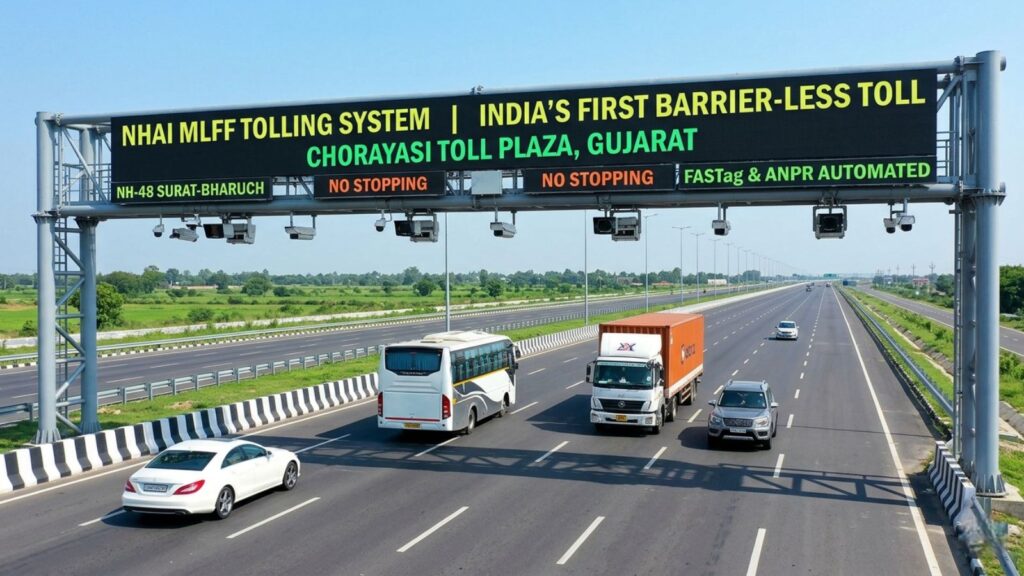
In a major step towards transforming the Electronic Toll Collection (ETC) system in the country, the National Highways Authority of India (NHAI) has successfully launched the Multi-Lane Free Flow (MLFF) based tolling system at the Chorayasi Toll Plaza on the Surat–Bharuch section of National Highway-48 (NH-48) in Gujarat. Around 41,500 vehicles crossed the MLFF toll location on the first day after the implementation of the system, demonstrating high commuter acceptance and operational efficiency.
The newly deployed framework introduces barrier-less tolling with minimal human intervention. It enables vehicles to pass through toll locations without stopping, ensuring completely seamless traffic flow.
The Technology Behind the MLFF System
The MLFF infrastructure replaces the conventional physical gates that cause congestion and delays. The framework is built on two primary technologies:
- Automatic Number Plate Recognition (ANPR): High-definition cameras capture and read vehicle license plates at highway speeds.
- FASTag Integration: The system continuously scans and cross-references tags against the central system for automated, contactless toll fee deduction.
The technology is expected to create a robust and cost-effective tolling ecosystem across the National Highway network.
E-Notice Framework and Penalty Rules
To ensure transparency and compliance, NHAI has urged National Highway users to maintain sufficient balance in their FASTag accounts. In scenarios such as an insufficient balance, invalid, or non-functional FASTag, the system will trigger a digital compliance procedure:
What Commuters Need to Know:
- E-Notice Generation: Users are issued an Electronic Notice (E-Notice) for non-payment of the user fee.
- Official Portal: E-Notices can be accessed and paid through the designated portal at https://nhfeenotice.parivahan.gov.in/.
- 72-Hour Window: Commuters are required to pay the normal user fee within 72 hours of the E-Notice being issued.
- Grievance Redressal: Users can raise grievances within 72 hours of receiving the E-Notice.
Non-Compliance Penalties
Failure to clear the standard fee within the 72-hour window will result in the toll fee being charged at twice the normal rate for the respective vehicle category. Furthermore, non-payment of E-Notices may result in blacklisting of the FASTag and restrictions on other vehicle-related services through the VAHAN platform.
Economic and Environmental Impact
The introduction of MLFF is set to revolutionize the Indian travel experience. By allowing vehicles to cruise at higher speeds without stopping at physical booths, the initiative will:
- Reduce congestion and traffic bottlenecks on crucial economic corridors.
- Significantly improve travel time and lower logistics costs.
- Enhance fuel efficiency and reduce vehicular emissions, moving the country toward greener highways.