
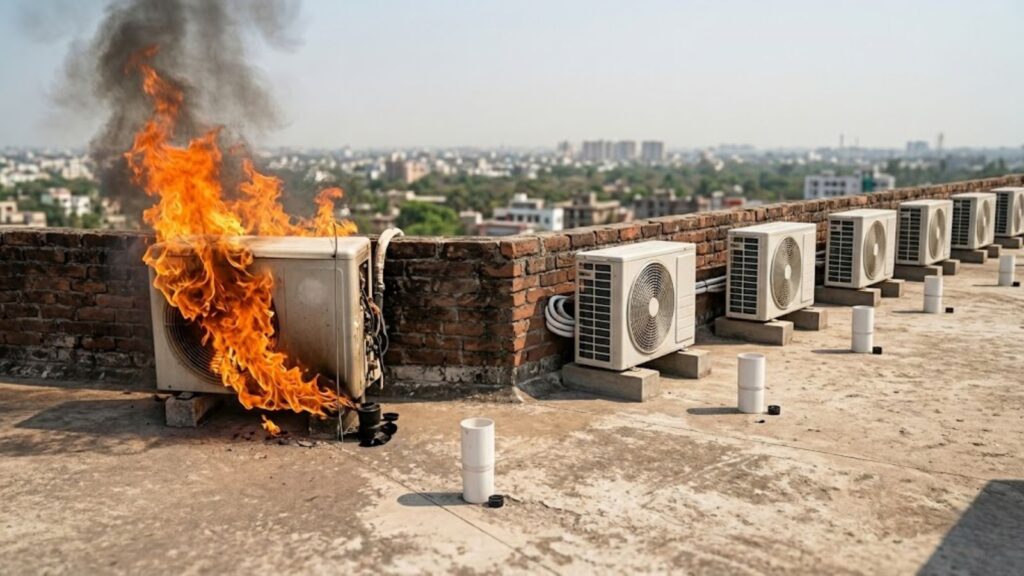

As the Indian subcontinent bakes under an unprecedented heatwave, news reports of air conditioning units catching fire or exploding are flooding the headlines. While most people are quick to blame electrical short circuits, the danger often lies right outside your home: the outdoor unit (ODU).
While the indoor unit circulates cool air, the true workhorse of your air conditioner is the compressor, located inside the outdoor unit. As it compresses refrigerant gas, temperatures can soar. If the ODU is placed in an inappropriate spot or neglected, the heat and pressure can rise to dangerous levels, turning your AC into a serious safety hazard.
To help you navigate this summer safely, we have compiled an essential safety guide to protect your home and ensure your cooling system operates safely.
Understanding the Danger: Why the Outdoor Unit Overheats
The outdoor unit houses the compressor, which generates extreme heat while compressing refrigerant gas. If the ODU cannot exhaust this heat, the internal pressure and temperature skyrocket.
In units containing flammable refrigerants, which are common in modern, eco-friendly models, a small spark caused by melting wires or electrical issues can ignite a fire or cause a rupture. Ensuring proper airflow and placement is the first line of defense against these incidents.
The Golden Rule: Clearance and Airflow
Most overheating issues stem from a lack of proper airflow. Whether your unit is situated on the ground, a balcony, or a terrace, you must enforce strict clearance rules:
- Maintain a 2-Foot Clearance: Ensure at least 2 feet (approx. 60 cm) of empty space on all sides of the unit.
- Remove Obstructions: Trim nearby bushes, remove grills, and make sure the unit isn’t tucked into a tight corner or enclosed porch. Blocked fins trap heat and kill the compressor.
- Manage Sunlight Exposure: The ODU should never face direct afternoon sun if possible. If it must be placed in direct sunlight, build a permanent shade (a louvered cover or awning) 3 to 4 feet above the unit.
- CRITICAL: Do not cover the sides or top tightly. The shade must allow rising hot air to escape.
Wall Mount vs. Ground Mount: Which is Safer?
Choosing the right mounting method depends on your home’s setup, but safety risks vary between the two:
- Wall Mounting (Urban Preference): This setup keeps the unit away from dust, kids, animals, and pooling rainwater. However, high vibration can occur. Safety Risk: Loose nuts can cause gas leaks. Always use heavy-duty, anti-vibration brackets.
- Ground Mounting: It offers less vibration and is easier to service. Safety Risk: Condenser coils can easily suck in dust and dry leaves. Verdict: Only use ground mounting if the unit is elevated on a raised concrete platform, never on bare earth.
The Maintenance Schedule to Prevent Disasters
Even with perfect placement, neglect will cause a unit to fail. Follow this preventative checklist:
- Monthly: Use a water jet or garden hose to gently spray the metal grills (the condenser coils). Accumulated dust acts as a thermal blanket, trapping heat.
- Quarterly: Check the condensate drain. If water gets stuck inside the outdoor unit, it leads to rust and electrical shorts.
- Yearly: Hire a certified technician to inspect the capacitor. A failing component makes the compressor work much harder, drawing excess current that can melt wires.
The Hidden Threat: Refrigerant Quality
The gas circulating inside your AC determines its overall safety. Cheap, adulterated, or mixed refrigerants are highly volatile. A minor leak combined with a dirty ODU can turn the entire unit into a blowtorch.
With India’s Quality Control Orders tightening norms, it is vital to avoid local mechanics offering cheap, uncertified gas refills. Always insist on a BIS-certified gas refill.
Final Verdict: Is Your Home Safe?
Before you go to bed tonight, walk outside to your AC’s outdoor unit. If you spot blocked airflow, direct sunlight exposure, animal nesting, or visible rust, call a technician immediately. Prevention is about more than just reducing electricity bills, it is about keeping your home safe this summer.
Disclaimer: Article for general information only. Consult a qualified professional before taking any decision based on information provided in this article.