
Imagine trying to predict a disaster using a map where most of the information is missing. For decades, that was the reality for flash floods. Unlike major earthquakes or hurricanes, which are tracked by massive sensor networks, flash floods are small, fast, and often happen in places where no one is watching with a scientific gauge. Scientists call this the “Data Desert.”
To fix this, Google didn’t look for more sensors; they looked at our collective memory: the news.
The Methodology: Mining ‘Unstructured Memory’
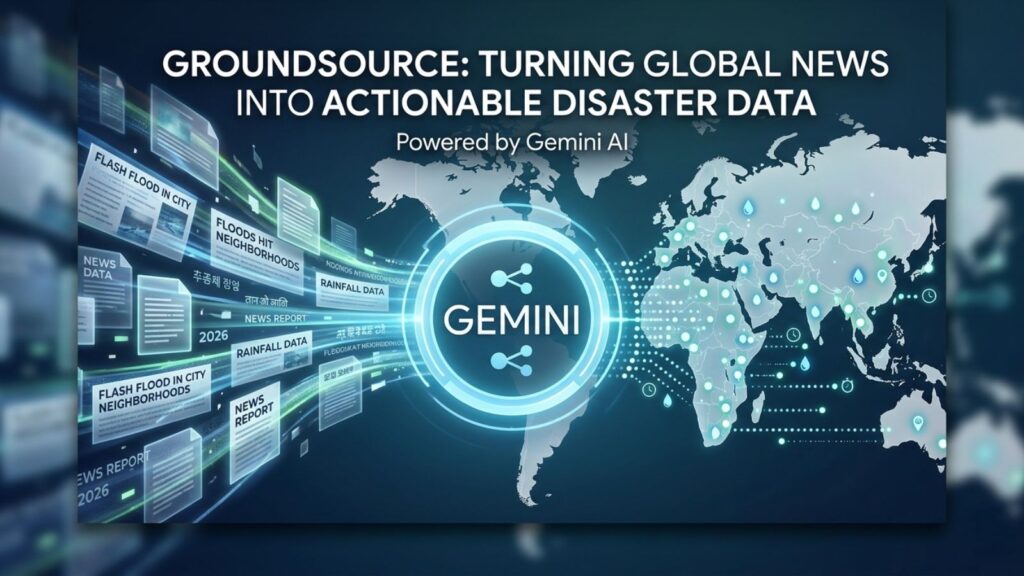
The genius of Google’s new tool, Groundsource, is that it treats every local news report from the last 20 years as a sensor. Here is the step-by-step breakdown of how Gemini turns a news story into a scientific data point:
- The Multilingual Listen: Using a specialized tool called the “Read Aloud” agent, Google scans millions of articles in over 80 languages. Whether it’s a local bulletin in Marathi or a neighborhood blog in Spanish, the system captures the text and translates it into a standardized format.
- The Gemini Filter: This is where the accuracy begins. A regular search engine might see the word “flood” and get confused by a headline about a “flood of applicants” for a job. Gemini acts as a high-level editor, specifically classifying reports to ensure they are about actual, physical water on the ground.
- Solving the ‘Relative Time’ Puzzle: News articles often use relative dates like “Last Tuesday” or “Yesterday afternoon.” Gemini cross-references these phrases with the article’s actual publication date to pin down the exact minute and hour the flood peaked. This creates a precise timeline that traditional databases often miss.
- Street-Level Mapping: While old records might just say a flood happened in “Pune,” Gemini can identify specific neighborhoods or even street intersections mentioned in the text. It then maps these to digital “polygons” using Google Maps, giving researchers a high-definition footprint of where the water actually went.
Why Is This More Accurate?
In the past, AI models were trained on about 10,000 “high-impact” events, mostly massive disasters that made global headlines. But flash floods are localized. By using Gemini to process the news, Google expanded that training set from 10,000 to 2.6 million events.
Think of it like a student studying for an exam: would you rather have a student who read 10 textbooks or one who read 2.6 million?
By training on this massive volume of “Groundsource” data, the AI has learned the “fingerprints” of a flood. It now understands how specific rainfall patterns interact with the unique pavement and soil of 150 different countries. Because the AI has “seen” so many past examples via the news, it can now recognize the warning signs of a flash flood 24 hours before it happens.
Moving From Reaction to Prevention
This isn’t just a technical achievement; it’s a shift in how we survive. By integrating these 24-hour alerts into the Google Flood Hub, the system provides a critical window for:
- City officials to clear drainage systems before the rain starts.
- Emergency services to pre-position boats and medical supplies.
- Families to move valuables and evacuate before roads become impassable.
By turning yesterday’s news into today’s data, Google is ensuring that even the most “unpredictable” disasters no longer catch us by surprise.